The First Tombstone Dedication at Seay Chapel Cemetery, Alexandria, Tennessee
There is a small lane behind Seay Chapel in Alexandria, Tennessee, that leads up a shaded path. If you didn’t know to look for it, you might pass it without a second thought. But walk that lane, step into the grassy area, and something shifts. The ground is quiet in a way that asks something of you. It asks you to slow down. To pay attention. To remember.
On the African American side, that hill holds an estimated 500 souls — men, women, children, infants, Civil War veterans, laundresses, farmers, mothers, fathers. For too many of them, the earth above has gone unmarked. Fieldstones displaced. Wooden markers long since dissolved back into the soil. Names nearly lost, and some we will never get back, as there may be upwards of 450 unmarked graves.
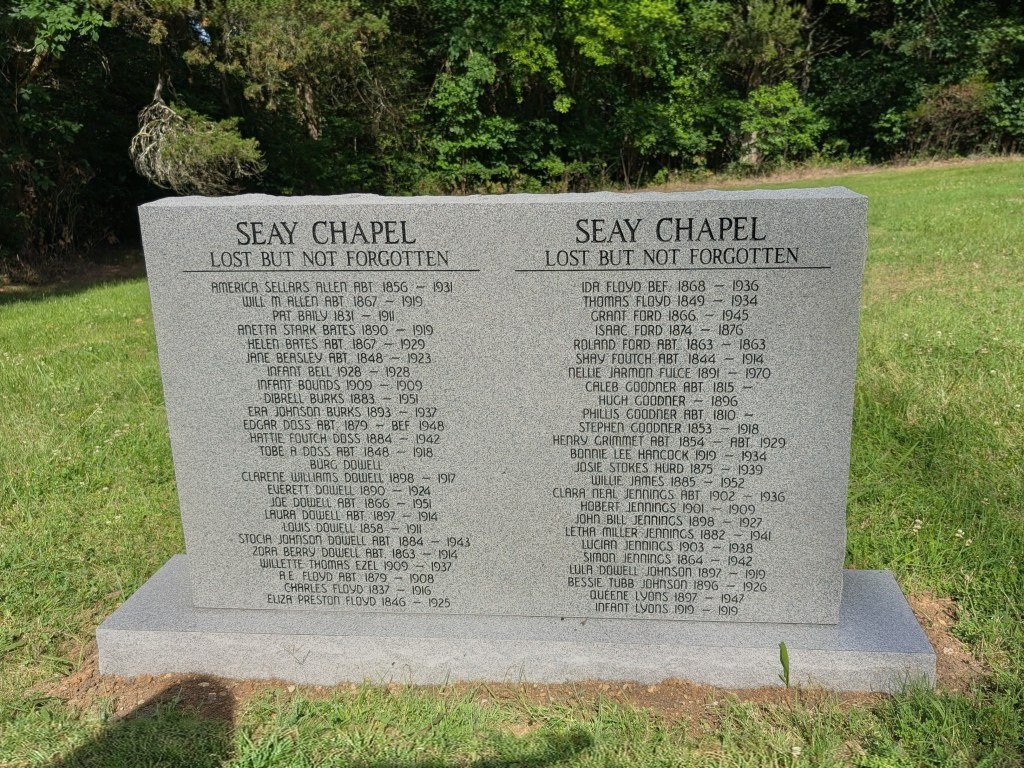
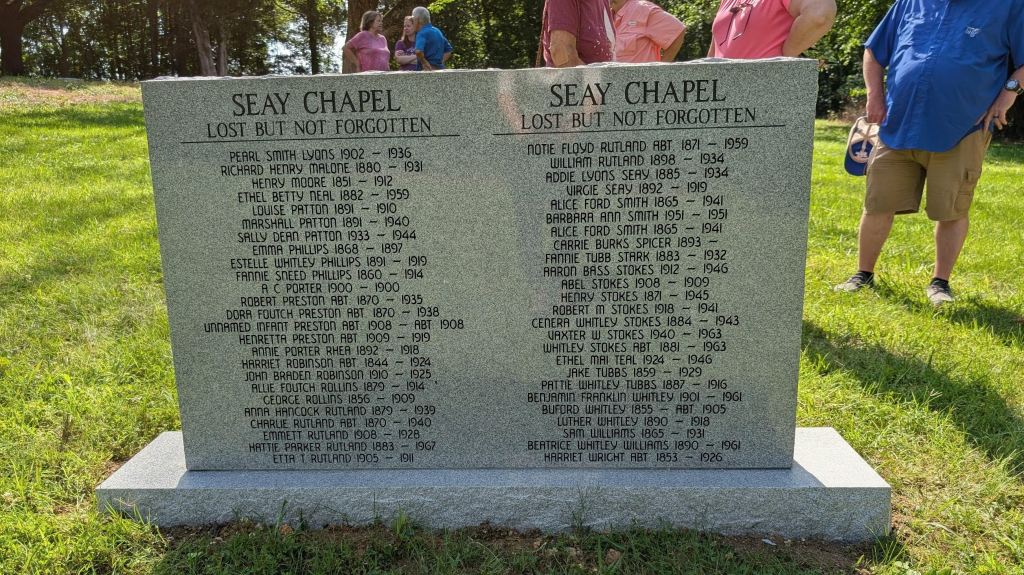
On this day, one hundred of those names returned to the light.
The Work That Made This Possible
A dedication like this doesn’t begin with a stone. It begins with people willing to focus on the greater good, to set all ego aside, and know that some things simply must be done.
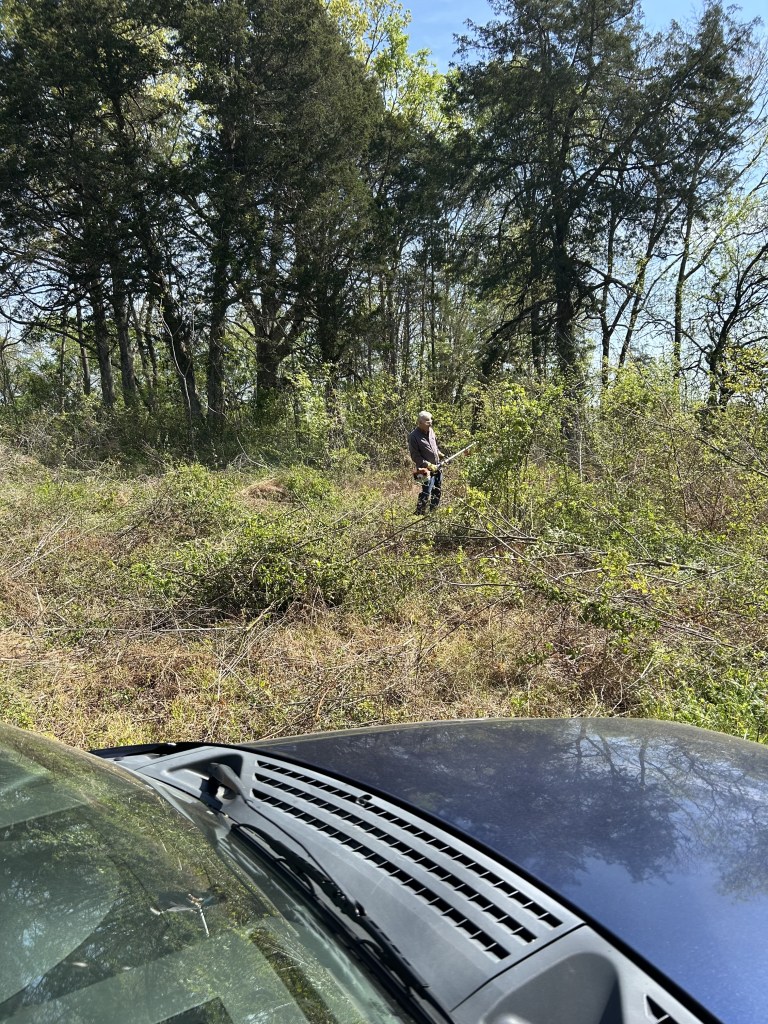
Before any research could be honored, the land itself had to be reclaimed. Ria’s husband Ricky gave days upon days to clearing the cemetery — so much brush, overgrowth, ticks, chiggers, and the accumulation of years of neglect — working tirelessly so that the ground could breathe again and be ready for the stone to be placed in a home that respected those named on it.
So that the sunken graves and the fieldstones and the traces of lives could once again be seen. The county came and hauled the brush away, a partnership Ria arranged that made the transformation possible. Melanie and her husband Frank showed up to clean and repair existing stones, their hands doing the careful, patient work of restoration, helping to lift stones that had fallen back into place, and righting the crooked ones.
Every hour of that physical labor was an act of love. Before a single name could be etched, someone had to make the ground worthy of the work. They did.
Along with this, the research began — hundreds of hours combing through census records, death certificates, wills, deed books, pension files, marriage licenses, newspaper clippings, and the sometimes-cruel silences between the records, and heart-wrenching moments crossing through the centuries with the words you read. Cross-referencing. Verifying. Connecting families across generations to make sure that every name on this stone belonged here, spelled the way it appeared during their lives, honored rightly.
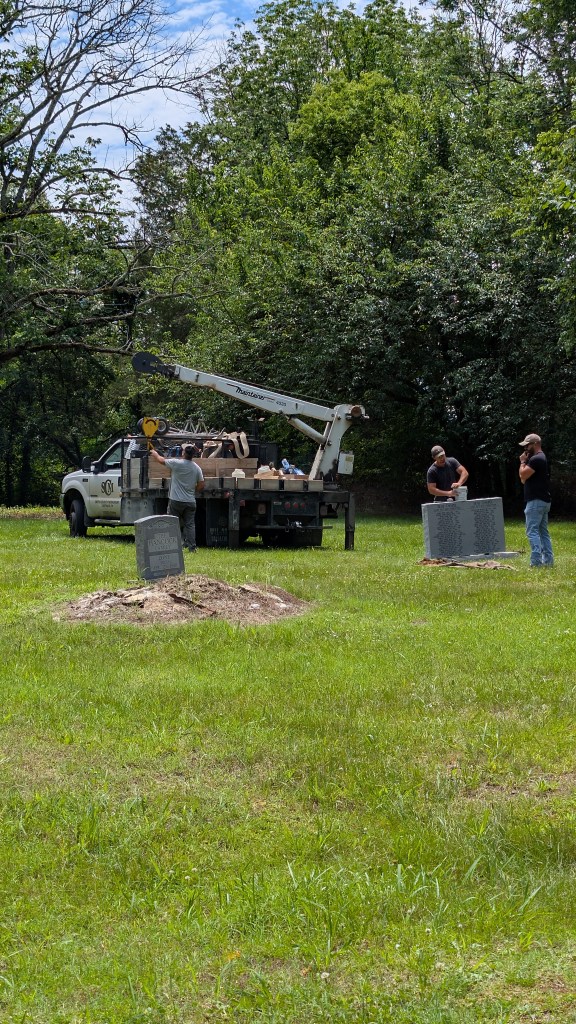
And when the names were finally ready, Kurt of Bass Funeral Home stood by to help see the work through to its final steps, making sure every name was laid out correctly, every detail accurate, before the stone ever touched the ground. He helped ensure that when it was placed, it rested as near to untouched, original ground as could still be found on that hill.
This is what a community looks like when it decides that the lives that shaped Alexandria’s formation matter.
A Daughter of a Soldier
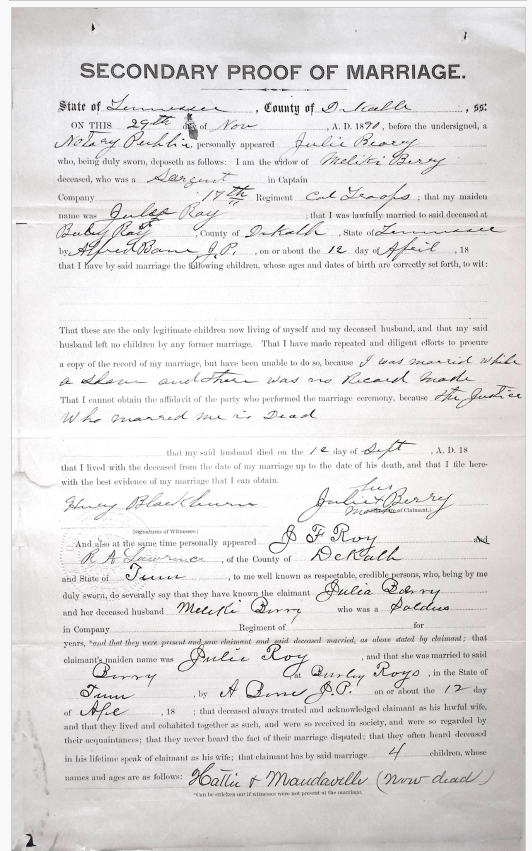
Among the one hundred names on this stone is one that carries particular weight for me, as it was a family of the first USCT pension file I located: Elzora Berry Dowell — known variously in the records as Zora, or Zula — born around May of 1863, born into Slavery, the daughter of Malachi Berry, a man who served his country in the 17th Regiment of the United States Colored Troops, and Julia Roy Berry, who did have a stone.
Malachi Berry — listed as Mack, Malachai, or Malaki depending on who was writing it down — was likely born around 1839, probably in South Carolina. He married Julia Roy in April of 1862, and he went to war for the Union, to fight for his family’s freedom. Based on the pension files, he died as a result of his service, making his way home shortly before his death.
His wife, Julia, applied for a widow’s pension in 1891. She gathered witnesses. She filed appeals. She waited four years. She was denied, as she could not prove his service, all for having the wrong regiment. And still she stayed in Alexandria, raised her children, worked as a laundress, and eventually owned her own home. She died in 1918.
Their daughter Elzora grew up in that world — the child of a man who gave everything and a mother who fought, quietly and persistently, for recognition that never came. Elzora married twice: first to N.E. Hays in DeKalb County in November of 1877, and then to Lewis Dowell in April of 1884. Together, she and Lewis built a family — Edgar, Virgil, James, Laura, Lula, and Nannie — six children raised in Alexandria, in the very community their grandparents had put down roots in. She is believed to have had 11 children, and we suspect those who did not survive are buried here. In time, her lost children will also be etched in stone, even if we cannot find their names.
The 1900 census finds her whole family living together in a home believed to belong to George Rollins, possibly Elzora’s grandfather — four generations under one roof in Civil District 1, DeKalb County. You can feel the gravity of it: a man of 69 at the head of the table, a likely daughter of 50 beside him, and around them the grandchildren and great-grandchildren who were his legacy, of his flesh, or if not flesh, of the soul.
Elzora Berry Dowell died on the 17th of February, 1914, in Alexandria, and was buried here at Seay Chapel Cemetery. She was only 51 years old.
Her name is now etched in stone, forgotten no more.
Queene Lyons Jennings
The records give us a life lived quietly and independently. Queene Lyons was born around September of 1897 in Wilson County, Tennessee, to Alford Lyons and Elizabeth Hancock Lyons. By 1900, she was a small child in a full household in Alexandria, surrounded by siblings — Zona, John, Buck, Anderson, Cora — her mother Bettie listed as head of the family.
By 1930, Queene was living alone, listed as head of her own household, a single homemaker who rented her home in District 1 of DeKalb County. The census notes she could read and write. She was her own person, making her own way.
She married Tom Jennings on the 7th of February, 1936. She died on the 29th of December, 1948, in Alexandria, and was buried here at Seay Chapel Cemetery.
Her death certificate lists the cause of death as “unknown.” A quiet woman, a quiet passing without children, a life that might have slipped entirely from the record. It has not — she has been remembered.
One Hundred Names
These are not simply names on a stone. They are whole souls, with marriages and children and losses and joys that the records barely touch on. These are a few among the one hundred remembered today:
Pat Baily (1831–1911), who lived eight decades in this community. Harriet Wright (about 1853–1926), who outlasted so much. Infant Bell (1928) and Infant Bounds (1909) — the tiny ones, gone before they had the chance to leave a mark on anything except the hearts of their parents. Bonnie Lee Hancock (1919–1934), just fifteen years old. Simon Jennings (1864–1942), who made it nearly to eighty. Ethel Mai Teal (1924–1946), gone at twenty-two. So many who died far away and were returned back to Alexandria
Caleb Goodner (about 1815–before 1900) and Phillis Goodner (about 1810–sometime before 1900) — a husband and wife born into slavery, buried together on this hill. George Rollins (1856–1909), the man in whose home the 1900 census found four generations sheltering together. Luther Whitley (1890–1918), who died the same year the Great War ended and a flu pandemic swept the world. Henry Stokes (1871–1945), who lived through all of it.
Virgie Seay (1892–1919). A name that connects directly to the very chapel near where she rests.
Willette Thomas Ezel (1909–1937). Clara Neal Jennings (about 1902–1936). Annie Porter Rhea (1892–1918). Women who married, built families, and died young — their names nearly swallowed by time.
Every one of them was once someone’s everything. Every one of them deserved to be remembered.
The Work Continues
A first stone is a beginning, not an ending.
Work is already underway on the names for a second stone, which we hope to place before the end of this year. Research continues, building out family trees from the 1870 census onward, connecting generations and accounting for each soul who called this community home. There are families still being traced. There are connections still being made, at leaast 4 stones will be needed, as we hope to honor all of Alexandria’s African American Community that we do not know their final home.
A community work party is planned for July 18th. If you want to be part of this — if you want to put your hands to the work of restoration — please come; watch our Facebook page for full details. Every pair of hands matters.
Beyond the stones, there are larger needs. The Seay Chapel wall needs repair — the first phase will require $6,000 to repair the fallen wall. Ground-penetrating radar, which would allow us to truly map the unmarked graves on both sides of the cemetery and determine just how many souls rest here, will require $10,000. These are not small asks. They are necessary ones, but every $1, $5, or $10 donation helps us toward the goal.
If you are in a position to donate, we ask that you do. As a registered 501(c)3, every donation is tax-deductible, and we will provide documentation accordingly, even if only a $1.
If you are a descendant of anyone buried at Seay Chapel Cemetery, please reach out. Your family’s story belongs in this record. Your knowledge may be the piece that helps us place a name correctly, honor a life accurately, and restore what time has tried to take. We have created a space for them to be remembered, their stories shared.
What the Ground Asks of Us
So many things in this world move so fast. News cycles, the electronic age, the relentless forward press of everything. It can feel impossible to stop.
But there is something about standing on a hill like this one, walking in the footsteps of W.E.B. Du Bois when he was here, feeling the quiet of it, understanding that beneath you rest five hundred human beings who laughed and grieved and worked and loved and were, in so many cases, nearly erased, that makes the case for stopping. For looking back. For remembering the paths that were walked before ours; for it is those who built this world whose legacy must be remembered, much like the stone masons who built the stones that can still be read. It is the common man who impacts the world more than one with notoriety.
The people on this stone did not ask for fame. They did not ask to be remarkable. They simply lived their lives in this corner of DeKalb County, and were buried here when those lives ended.
They asked, in the only way the dead can ask, to be remembered.
Today, we answer that ask. One hundred names, etched in stone, standing on a little hillside in Alexandria.
Forgotten no more.
To donate, volunteer for the July 18th work party, or share information about ancestors buried at Seay Chapel Cemetery, please reach out through the project contacts. Tax-deductible receipts are available for all donations.
Donations can be made at the Wellworth Bank account “Friends of Alexandria’s Historic Cemetery District,” or sent to PO Box 14, Alexandria, TN. We simply need to know who you are and how to send the tax receipt.
You can reach us by email at info@friendsofalexandriashistoricdistrict.org.
One response to “One Hundred Names Returned to the Light”
-
This is an amazing testimony to our roots and must not be forgotten. Thank you for all the hard work, obviously difficult and tedious research that is presented here. However it may reveal of us as a country both good or bad lest we not forget those who built the Americas we live in today. Alexandria has such a rich history and we must celebrate all of those who came before us and the impact of their lives on our historical town. I’m proud to be a resident of Alexandria and the state of Tennessee. I’m excited to see the Seay Chapel Cemetery tombstone. Thank you for sharing. I look forward to more of our history shared
LikeLike


Leave a Reply