
Reprinted with Permission from Mitzi Freeman – Originally found on the MTGS issue XXXI No. 1
The Allison Murders in Putnam County (part 5) by Dr. Mitzi P. Freeman
continued from the Spring 2017 issue (vol. XXX, no. 4)
In 1883, William Brimage Bate (no relation to Dol Bates) became the new Governor of Tennessee. The quest to pardon Bates continued through his term.
- 29 June 1883, Washington, DC: Colonel Thomas Waters, former Warden of the Tennessee Penitentiary and former Major of the 4th Tennessee Mounted Infantry USA, wrote that while he was the Warden, he had the opportunity to observe Bates as a prisoner. He remarked, “there was not a better convict within the walls.”
- 29 May 1884, Smithville, TN: Bethel Magness Webb from the law firm Gribble, Webb & Ayant had been the first lawyer employed by the State to prosecute Bates. After being on the case for some time, he resigned; because he felt that Bates was being wrongly prosecuted. Bates’ conviction was based solely on Johnson’s testimony. He felt that Johnson was a “worthless unreliable scoundrel” and that the other witness’s testimonies were “rickety & unsatisfactory at least to his mind.” Bates father was quite old and was in need of his son’s help. Webb closed by saying that he hoped the Governor would consider his application and pardon him.
- 17 June 1885, Smithville, TN: The men who served on the jury in Bates’ second trial signed a petition asking the Governor to pardon Bates.
- 18 January 1886, Nashville, TN: F. S. Harris, Warden of Tennessee Penitentiary, wrote to say that Bates had served nearly six years. A new “Good Time Law” was recently passed but had yet to take effect. This new law would entitle Bates to be released on 19 October 1886. He regretted that Bates had been incarcerated so long. 19 January 1886, Lebanon, TN: Robert Emmett Thompson, a renowned Criminal Defense Attorney, wrote that he had received a letter from Dol Bates, who said that his prison time would be up if he were
allowed to use the Good Time allocation. - 02 September 1886, Nashville, TN: Andrew J. Hooper, Warden of the Tennessee Penitentiary, and F. H. Cass, Deputy Warden, recommended Bates for pardon based on his excellent conduct during his incarceration.
- 1886, DeKalb County, TN: Sixteen members of the DeKalb County Bar Association signed a petition saying that since Bates had served a considerable portion of his ten-year sentence, had good character prior to the murders, and since his father now needed his help, they requested that the Governor give him a pardon. In addition to these personal letters, there were eight separate petitions sent to Governor Bate asking him to pardon Bates. They cited Bates good character prior to the murders and the dire financial and personal circumstances of his father

Life After Prison
After becoming a free man, he and his wife remained in DeKalb County only a short time before moving to Elkmont, Limestone County, Alabama. They lived there for two years before deciding to try their luck out west. They settled in Fort Worth, Tarrant County, Texas for about two years and then moved to Thurber, Erath County, Texas, remaining there about nine years.
Finally, they moved to Jarilla Junction, Otero County, New Mexico. Bates worked in the mines as miner for the rest of his years. He and his wife never had any children. He was never in trouble with the law again.
Bates died of acute indigestion on 8 June 1922 and was buried in the Alamogordo Cemetery in Alamogordo, New Mexico. His obituary appeared in the 16 June 1922 issue of the Alamogordo Cloudcrofter.
DEATH OF WM. B. BATES – The death of W. B. Bates occurred at his home at Orogrande suddenly last Thursday. The body was brought to this city for interment Friday, Rev. A. N. Porter conducting the funeral services at Geren & Hammond undertaking parlors.
William Bell Bates was a native of Tennessee, and had resided at Orogrande since 1899, and at the time of his death was 75 years of age. For many years he had been engaged in mining operation. Mr. Bates during the reconstruction period served with the Federal forces. He was a man of kind disposition, and had many friends who were greatly shocked to learn of his demise. He is survived by his wife, and also a brother, who lives in Tennessee.
Epilogue
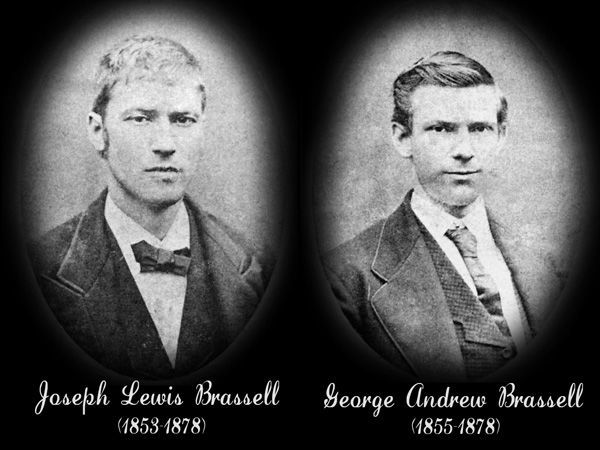
After the public hanging of Jo and Teek Brassell on Billy Goat Hill in Cookeville on 27 March 1878, Putnam County slowly returned to normal. After the conclusion of Bates’ second trial in March 1879, DeKalb County made its slow progress back to normal. The interest in both cases died down, and those intimately involved in the tragedy returned to their lives.
JOSEPH C. ALLISON – After the murder of his two older brothers, Joe continued to live with his stepmother, Angie, and her second husband, James Isbell. Sometime in the late fall of 1878 or early winter of 1879, Joe became seriously ill with a lung ailment. Throughout his illness, Angie tenderly took care of him. In her testimony at Bates’ Trial in March 1879, Angie stated that Joe was near death. He lingered until November 1879. At the time of his death, he was only 20 years old and had never married. The location of his grave is unknown. He is probably buried in an unmarked grave in the Rhea Cemetery in Putnam County near his parents and his brothers.
ANGELINE (BEASLEY) ALLISON ISBELL – After the murders, Angie continued to live in the Allison/Isbell home. She nursed both her stepson Joe and her second husband James Isbell throughout their illnesses. James died on 26 April 1880. On 4 April 1891, Angie sold the house and lands to James H. Lee. Where she lived after she sold the Allison lands is unknown. In her Last Will & Testament dated 24 November 1892, she made several bequests to family members, including her brother and members of the Allison and Isbell families.
According to the Allison Family Bible, Angie died in November 1892 putting the date of her death between 24 November – 30 November 1892. It is unknown where she is buried. Possibilities include an unmarked grave in the Rhea Cemetery near her first husband, in the Cookeville City Cemetery near her second husband, or in the Beasley Family Cemetery near her brother.
AMANDA PIPPIN – Not much is known about Mandy after the shooting. She continued to live with Angie until after the 1880 census. She never married and died on 6 February 1888. She is buried near her family in the Whitson Cemetery in Putnam County.
ARCHIBALD BRYANT – Arch married Mary Frances Bryant about 1876, and they raised a family of thirteen children. Arch died 7 January 1913 and is buried in the Bryant Cemetery in Putnam County.
LEANN (MAXWELL) ALLISON – After the murder of her husband, Leann never re-married. She continued to live and raise her children on the land that she and her husband owned. She died 22 October 1915 and was buried next to her husband in the Rhea Family Cemetery in Putnam County.
JAMES REUBEN BRASSELL – Despite many rumors of his arrest after the public hanging of his brothers, Jim was never charged or tried for any crime relative to the Allison murders. Jim and his wife raised a family of ten children. He stayed out of trouble until the spring 1898.
On Sunday 3 April 1898, Jim and his two sons Claude and Clay murdered Giles Bradford Jr. They were tried three separate times. In the final trial, Jim and Clay received two years in the Tennessee Penitentiary while Claude received six years. Jim died 30 March 1926 and was buried in the Odd Fellows Cemetery in Putnam County.
DOBSON YEARGAN JOHNSON – Dobson Johnson was directly credited for helping to bring the Brassells to justice and for helping to break up the High Curtis Gang. He testified in the Brassells’ trial, in both of Bates’ trials, and in the Curtis trials held in Smith County. In return for his testimony, he was never charged with any crime related to the murders of the Allison Brothers or to the activities of the Curtis Gang.
A spectator at the Brassells’ trial described Johnson’s demeanor on the witness stand as follows “While on the witness stand, in the Brassell case, he told what was believed to be a frank, straightforward story. He is a man of such phlegmatic temperament that all the sarcasm the defending lawyer could bring to bear did not excite him in the least.” As the Defense Attorney peppered him with questions, Johnson calmly admitted that he had been present at the Allison/Isbell home on the night of Russ’s murder, been present at the New Middleton Store on the night the Curtis Gang robbed the store, and that the boots he was currently wearing were stolen from that store. He gamely informed the court that he was wearing a size 10 on one foot and a size 11 on the other.
In 1886, Johnson applied for a pension from the Federal Government for his alleged service in the Union Army. The Pension Board denied his request, because they could not find his name on the military rolls. Although two comrades sent affidavits to the Pension Board on Johnson’s behalf, the Federal Government never approved his application.
By 1900, Johnson and his wife had eleven children, eight of which were still living. Mary, his wife, died between 1900 and 1904. In 1904, he married a widow named Emma. Johnson died 21 October 1911. Although it is unknown where he is buried, he is probably buried in an unmarked grave near his family in the Dismal Cemetery in DeKalb
County.

Mitzi P. Freeman, Ph. D., has been doing genealogical research for nearly 20 years. Her interests are primarily in Putnam, Jackson and White counties. She hosts a website called TNGenes Genealogy at http://tngenes.net. She can be reached at tnresearch@tngenes.net.
i Dol Bates Wanderings – How He Happened to Wind Up in the Davidson County Jail – Where He Has Been Since His
Disappearance.” Daily American [Nashville, TN] 21 Apr 1878: 1, hereinafter cited as “Dol Bates Wanderings.”
ii “Dol Bates Captured – The Accomplice of the Brassell Brothers Overhauled in Cannon County.” Daily American, 20 Apr 1878:
4., hereinafter cited as “Dol Bates Captured.”
iii “Dol Bates Wanderings.”
iv Ibid.
v “DOL BATES’S ESCAPE – Suspicious Conduct of the Officer Who Let Him Get Loose – Indicted for Complicity in the Affair.” Daily
American, 14 July 1878: 3.
vi “Bates Recaptured – How It Was Done – In Jail Here Again.” Daily American [Nashville, TN] 19 Jul 1878: 4.
vii “A Mixed Business.” Daily American [Nashville, TN] 20 Apr 1878: 4.
viii “Dol Bates Captured.”
ix “Dol Bates.” Fayetteville Observer [Fayetteville, TN] 05 Dec 1878. Chronicling America: Historic American Newspapers. Lib. of
Congress. http://chroniclingamerica.loc.gov/lccn/sn85033395/1878-12-05/ed-1/seq-2/
x State vs W. B. Bates, alias Dol Bates, Tennessee Supreme Court Case Files. Tennessee State Library & Archives, Nashville, TN. Box 56.
xi Prison Records, State of Tennessee 1831-1992. Vol. 51, Convict Records: State Penitentiary, Nashville, TN Book B 1877-1882.
Record Group 25. Roll #15. Prisoner #3619.
xii “THE PENITENTIARY FIRE – One of the Largest Manufacturing Establishments in the South Destroyed.” Daily American [Nashville, TN] 6 Dec 1881: 4.
xiii Governor William Brimage Bate (1826-1905) Papers 1883-1887 (1964): Tennessee State Library and Archives, Microform, Roll #5. Application for Pardon – W. B. Alias Doll Bates.
xiv Ibid.
xv Ibid.
xvi Angeline Isbell to James H. Lee, Putnam County, Tennessee Deed Book P, Page 542.
xvii “Testifying in Stolen Boots.” Daily American [Nashville, TN] 23 Apr 1878: 4.
 Alexandria Historic Cemeteries District
Leave a comment