
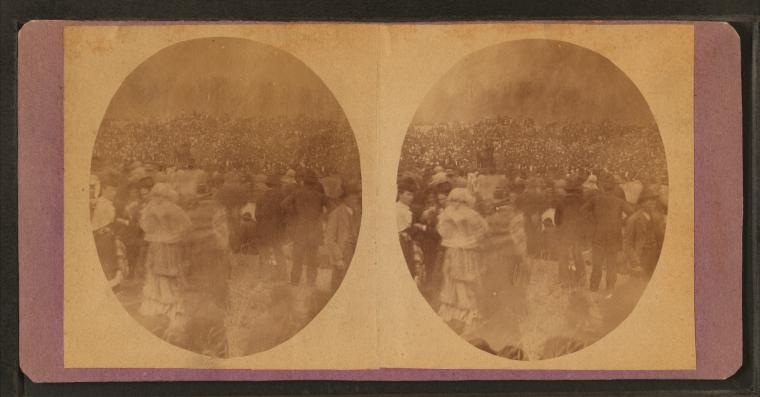
Reprinted with Permission from Mitzi Freeman – Originally found on the MTGS issue XXXI No. 1
The Allison Murders in Putnam County (part 5) by Dr. Mitzi P. Freeman
continued from the Spring 2017 issue (vol. XXX, no. 4)
Once free, Bates ran to James H. Overall’s mill. He spotted an old axe in a woodpile and used it to break the handcuffs. He then headed toward Smithville and hid out of sight near a public road. When he spotted his father heading to court, he called out to him. Bates Sr. expressed surprise at seeing his son free from authorities. Bates told his father to go see the Judge and tell him that he would turn himself in if the Judge would agree to give him bond.
Sheriff Doss was again commissioned to apprehend Bates. When he heard of the conversation between Bates and his father, he used this information to his advantage. He began “working” with Bates’ family and friends; promising them that if Bates would turn himself in, he would be allowed to give bond and would receive the minimal punishment for his latest escape.
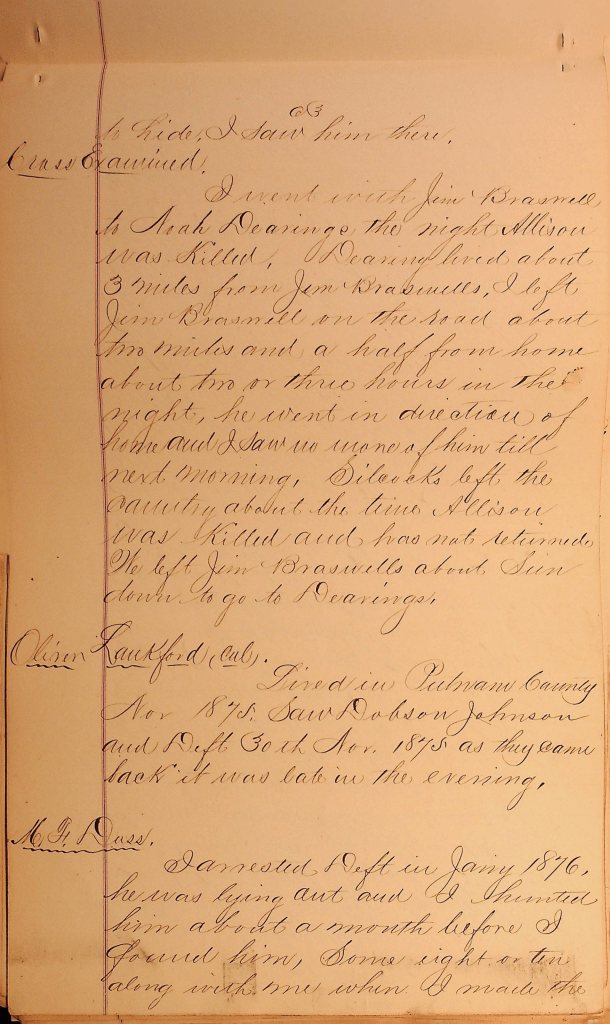
Bates’ attorney, William B. Corley, made an arrangement with Judge McConnell where Bates would be allowed to give bond immediately. Once this information was relayed to Bates, he approached Sheriff Doss and voluntarily gave himself up. He was immediately arrested without being allowed to post bond. The Sheriff had lied to him.
Both Bates and his attorney were angry about the turn of events. While Doss was busy tying a rope around Bates hands, Bates’ attorney attempted to distract the sheriff. Bates jumped up and started to strike Doss with a stick. Doss quickly drew his pistol and pointed it at Bates. Bates promptly took his seat, and the attorney left in a hurry.vi
Both Bates and his attorney were angry about the turn of events. While Doss was busy tying a rope around Bates hands, Bates’ attorney attempted to distract the sheriff. Bates jumped up and started to strike Doss with a stick. Doss quickly drew his pistol and pointed it at Bates. Bates promptly took his seat, and the attorney left in a hurry.

DOL’S STORY OF HIS ESCAPE
After leaving this place I arrived at Liberty about two or three o’clock A.M., I should judge on the night of the 10th. I was handcuffed to Capt. Armstrong. Having to unharness the mule, he found it difficult to get around while being handcuffed to me, so he took the handcuff off of his wrist and put both on me; then he took the harness off of the mule and I went ahead of him into the stable, followed closely by Capt. Armstrong. The night was pretty dark, the moon having just gone down. Capt. Armstrong was only three or four feet from me. I took advantage of the situation, the darkness, and my being handcuffed along, and ran right away from him. I went from there to Overall’s mills, and I saw an old ax in a woodpile, and I broke the handcuffs off. I then went toward Smithville and remained near the public road all day, where I could see everybody pass, and I saw my father on his way to attend the court at Smithville. He was surprised to see me, and I told him to go to Smithville and see the Judge and tell him I would give myself up, if he would let me give bond. I never heard anything more about the bond for two or three days; then my attorney, W. B. Corley, Esq., made arrangements with Judge McConnell to allow me to give bond immediately, and this is what caused me to surrender myself. I was not captured. I came to Smithville of my own accord. I presented myself to Sheriff M. F. Doss, of DeKalb county, and I told him that I came to surrender, and that my bondsmen were there. He refused to take the bond and hurried me here without any explanation. I surrendered on the 17th of the month. I have been more than anxious for a trial, for I can easily prove that I am not guilty of the charge. I never would have made my escape, nor would I have attempted to do so, but I have been treated most shamefully by these Sheriffs.
Doss asked me to say something in his favor when I arrived here, as to his kind and gentle treatment toward me while en route to this place. All that I can say is, that I would not treat a dog as he treated me. I must say that he treated me most shamefully, insulting me on every occasion, and using his position to make me as miserable as possible. I did not wish to make my escape, but I could not stand the treatment that I received at their hands, and consequently I ran away. I gave myself up thinking that I would be put in hands that would use me more like a human being. I do not do this to create any sympathy; all I do this for is to make a true statement in regard to my escape and my surrender to the Sheriff.
Yours truly, W. B. Bates N. B. – This Sheriff M. F. Doss, is a candidate for Circuit Court Clerk at the next election, and he has ill used me, thinking that he will gain more votes by it. W. B. B.”
Jailer Yarbrough and Deputy Morrow refuted Bates’ claim of mistreatment by Sheriff Doss by saying “Mr. Doss has served three terms as Sheriff of DeKalb county – as long as he can legally serve – and has always conducted himself in a manner highly satisfactory to the people of that county.”

Bates’ Trials
THE FIRST TRIAL
Bates remained incarcerated at the Nashville jail until his case came to trial on 8 November 1878. He plead not guilty. Many of the same witnesses appeared in this trial as appeared in the Brassell trial.
The defense subpoenaed Jim Brassell to testify that Bates had stayed the night at his house and had not gone to the Allison/Isbell home. Jim adamantly refused to testify, because he feared arrest or assassination. He was eventually jailed for his refusal to testify.
The case was handed to the jury on Saturday 9 November, and they returned Monday morning with a verdict of guilty of murder in the first degree. Bates showed little emotion when the verdict was read.
In court the next day, Bates’ attorney requested new trial based on the actions of one of the jurors. The attorneys produced several depositions, which stated that juror Bennett S. Turner had discussed the case with other people. In each conversation, Turner condemned Bates and expressed his belief that Bates was guilty. In addition, it was shown that Turner had separated himself from the other jurors and was unaccompanied by an officer of the law on at least one occasion.ix The Judge granted a new trial set for March 1879. Bates was denied bail and returned to the Nashville jail.
THE SECOND TRIAL
The second trial began Monday, 10 March 1879. This trial preceded much in the same way as the earlier trial with all the same witnesses called.
The case was handed to the jury on Saturday, and on Monday they returned with another guilty verdict, but this time it was in the second degree. Bates was sentenced to 10 years of hard labor in the Tennessee State Prison. The judge concluded the trial by saying that Bates could appeal his sentence to the Supreme Court in Nashville

Taken by J. Fletch Woodward on 27 March 1878 in Cookeville, Tennessee
SUPREME COURT
On 18 January 1880, the Supreme Court upheld Bates’ conviction and prison sentence. He was, then, transferred to the Tennessee State Penitentiary to begin serving his prison sentence.
Prison and Pardon
PRISON
On 20 January 1880, the Tennessee State Penitentiary received Dol Bates as Prisoner #3619. He was 32 years old and described to be 5’ He solemnly affirmed to his mother, on her deathbed, that he was innocent. Letter to the Governor 11 1/4” tall, weighing 162 lbs., with grey eyes, dark hair, and a dark complexion. He had a scar on the inside of his right ankle. He was born in Tennessee, married, and by trade a mechanic. He had a moderate education and expressed no religious preferences.x
During his incarceration, a significant event took place and would ultimately play an important role in Bates’ pardon. The prison caught fire on 6 December 1881. The fire started in the machine shop when a convict accidentally dropped a blazing coal into a blackening tub. The blaze engulfed the machine shop and spread rapidly through the prison. Panic and pandemonium broke out among the prisoners. Instead of using the confusion as an opportunity for escape, most prisoners helped officials put out the blaze by forming long lines and passing water buckets up and down the lines. Of the 728 prisoners incarcerated, only six escaped. All were later captured.xii
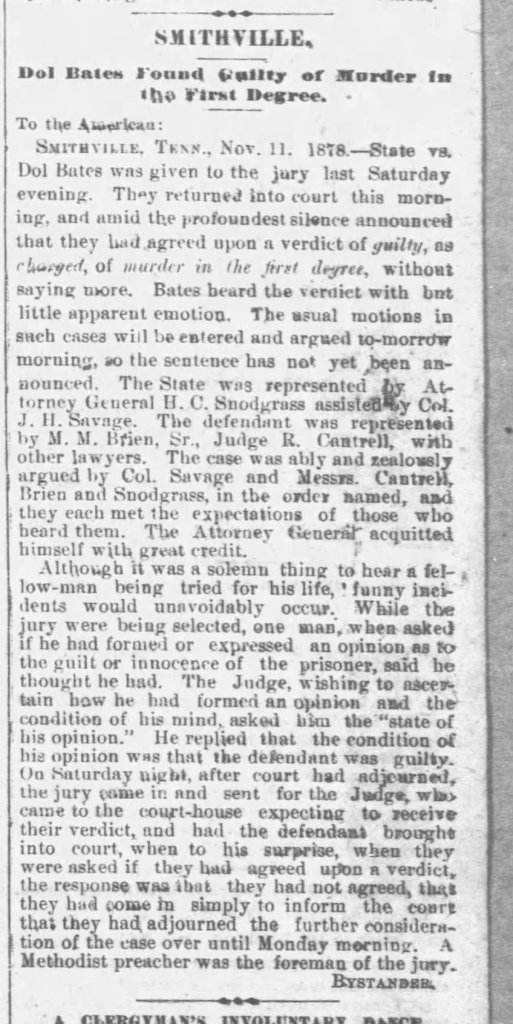
Rather than making his escape, Bates rendered aid to the injured and helped to put out the fire. Warden Thomas Waters later commended his efforts in a letter to Governor Albert Marks. He wrote “I especially noticed the conduct of W. B. alias Dol Bates a convict from DeKalb County from the fact that I had known him for years. I can say there was not a better convict within the walls. He could have easily made his escape the day of the fire in Dec 81 – but upon the contrary he came and tendered his services to me and the other officials and rendered efficient service.”
PARDON
By late 1882, Bates had been in state prison for nearly three years. His lawyers, family and friends began a campaign to encourage the Governor of Tennessee to issue him a pardon. He had several influential friends who attempted to intercede on his behalf.
In 1882, Governor Alvin Hawkins received the following letters.
28 November 1882, Dowelltown, TN: Captain Ezekiel Bass, former Captain in the 5th Tennessee Cavalry USA, wrote to say that he had known Bates all his life, and he was a good boy. He did not believe that Bates was guilty of the crime and was requesting that he get a reprieve.
30 November 1882, Smithville, TN: Judge Wingate T. Robinson, County Judge for DeKalb County and former 1st Lieutenant in the 5th Tennessee Cavalry USA, wrote to say that the public sentiment of the people was unanimously in favor of Bates receiving a pardon. Bates’ elderly father had spent all his money to provide lawyers for his son and was now dependent on his neighbors for his support. He believed that Bates would make a good citizen.
04 December 1882, Alexandria, TN: Colonel William Brickly Stokes, former Tennessee Representative to United States Congress (1859-1861) and former Colonel of the 5th Tennessee Cavalry USA, wrote to say that he had done some personal investigation in the Allison Murders and was satisfied that Bates was not with the Brassells the night of the murder. Stokes included a petition with 126 signatures from citizens of DeKalb County, who wished to see Bates receive a pardon. Having known Dobson Johnson since he was an infant, Stokes opinion of him was that he was a “low down worthless creature.” He closed by saying that he felt Bates had suffered enough.
To be continued…
Mitzi P. Freeman, Ph. D., has been doing genealogical research for nearly 20 years. Her interests are primarily in Putnam, Jackson and White counties. She hosts a website called TNGenes Genealogy at http://tngenes.net. She can be reached at tnresearch@tngenes.net.
“Bates Recaptured – How It Was Done – In Jail Here Again.” Daily American [Nashville, TN] 19 Jul 1878: 4. vii “A Mixed Business.” Daily American [Nashville, TN] 20 Apr 1878: 4.
“Dol Bates Captured.”
“Dol Bates.” Fayetteville Observer [Fayetteville, TN] 05 Dec 1878. Chronicling America: Historic American Newspapers. Lib. of Congress. http://chroniclingamerica.loc.gov/lccn/sn85033395/1878-12-05/ed-1/seq-2/
State vs W. B. Bates, alias Dol Bates, Tennessee Supreme Court Case Files. Tennessee State Library & Archives, Nashville, TN. Box 56.
Prison Records, State of Tennessee 1831-1992. Vol. 51, Convict Records: State Penitentiary, Nashville, TN Book B 1877-1882. Record Group 25. Roll #15. Prisoner #3619.
“THE PENITENTIARY FIRE – One of the Largest Manufacturing Establishments in the South Destroyed.” Daily American [Nashville, TN] 6 Dec 1881: 4.
Governor William Brimage Bate (1826-1905) Papers 1883-1887 (1964): Tennessee State Library and Archives, Microform, Roll #5. Application for Pardon – W. B. Alias Doll Bates.
 Alexandria Historic Cemeteries District
Leave a comment