
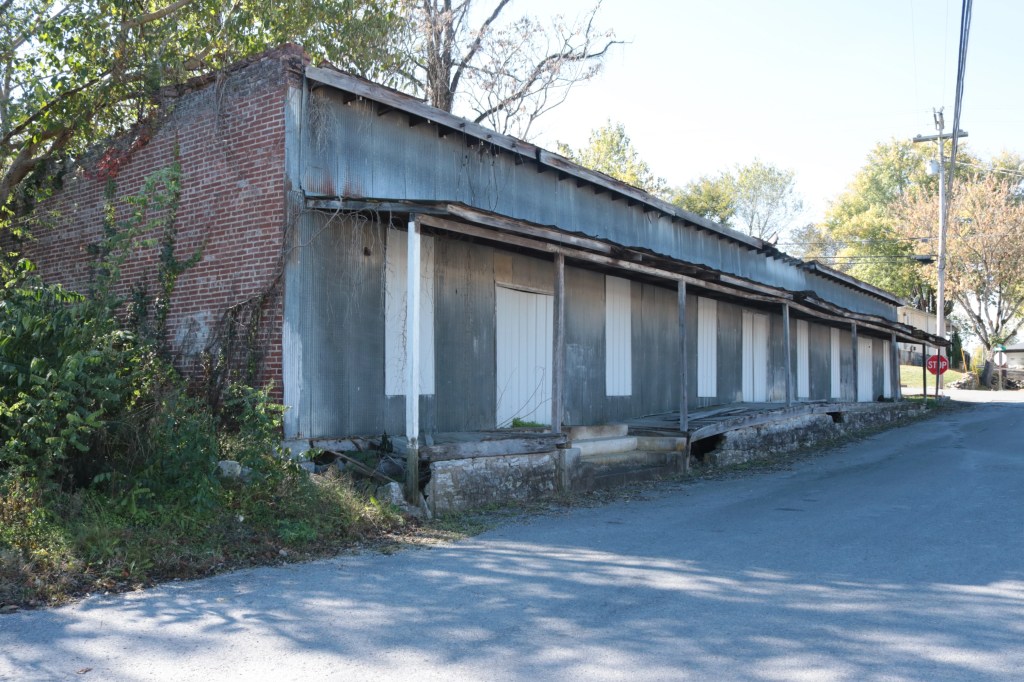
This story starts around 1806 in Smith County, Tennessee, very briefly, before DeKalb County’s formation, Alexandria’s location also fell into Wilson County due to shifting borders, but it quickly reverted to Smith County. Alexandria fell into Cannon County for a short time in 1837. This was due to a slight shift in nearby boarding lines. If you are looking for records for Alexandria it is imperative to search in all four counties, as they are very intertwined. Will T. Hales books says the first settlers were to believed to have arrived about 1795.
The town’s founding, traces back to Daniel Alexander, who purchased land from Charles Kavenaugh on August 5, 1806. Daniel Alexander purchased 200 acres from Kavenaugh for $1,700, as recorded in Smith County Deed Book B, page 419.
Historical records suggest Daniel Alexander initially laid out 24 lots in Alexandria, each measuring 66 feet by 165 feet. Early town planning did not include a central square but did designate a business district. Early residents included notable names like the Goodners, Andersons, and Reece Tavern operators, with homeowners such as Thomas Allison, William Floyd, Widow Moore, and Isaac Myers. Later settlers included J.D. Wheeler and John Yeargin.
The land was located along a fork of Hickman Creek and Goose Creek. The deed specified that one acre was to be reserved for a meeting house previously conveyed to trustees. However, no record of this meeting house has been found in the surviving deed books, suggesting it may have been documented in the now-missing Deed Book A or never officially recorded. As with all early records, deed books are invaluable primary sources and susceptible to human error and gaps.
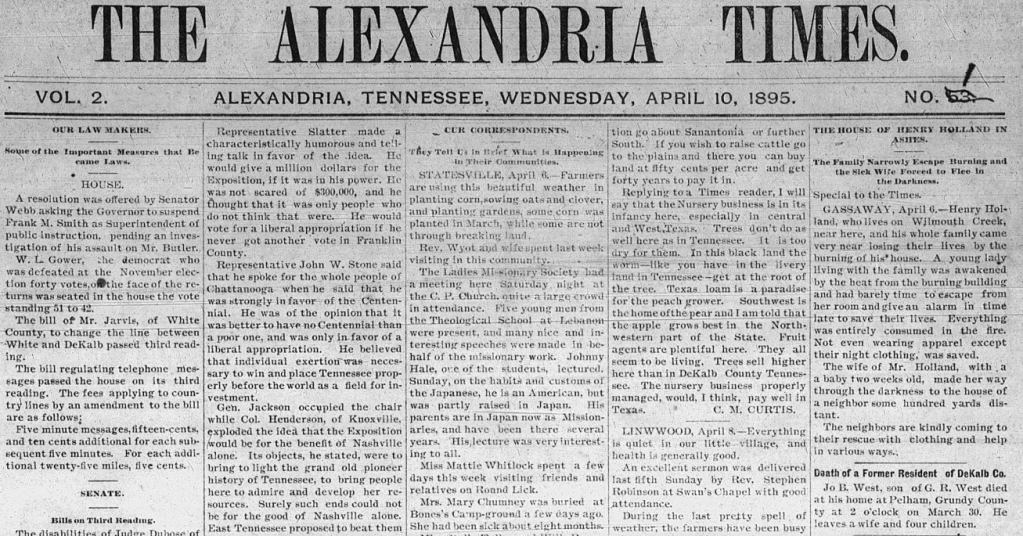
There are recorded memories of the land between today’s town square and Hickman Creek of a meeting house, schoolhouse, and graveyard. Unfortunately, recurring floods destroyed these structures, and it is uncertain if any remains still exist. Erosion and natural flooding were suspected to have displaced the graves well before 1900; even with ground penetrating radar, given the fill that has gone into the area, it is doubtful they are there. It is hoped that one day, a tombstone or plaque will be placed in the parking area to pay homage to those who are gone without names.
When DeKalb County was officially established in 1837, Alexandria became a part of it. The town’s post office opened in 1838, the first tax list appeared in 1839, and its first census was recorded in 1840. In these early records, the Alexandria area was categorized as District One. In speaking with Ria, it is believed that the state incorporated date for Alexandria was on Jan. 31, 1849, it was unincorporated after the four mile law, which was a ban on alcohol inside city and outside limits for 4 miles, three different times and the reincorporated in 1913 we have been incorporated ever since.)
A post office called Kavanaugh was established on October 1, 1807, with Daniel Alexander serving as the postmaster. On April 1, 1808, Charles Kavanaugh was the post master and here ends the record of the now extinct office. (This information is from the Smith County History page 9 written by Sue W. Maggart).
Daniel Alexander did not remain in DeKalb County long; he eventually moved to Rutherford County, where he died in 1857. After leaving Alexandria, it appears Alexander rented his home to Jacob Fite. Nevertheless, Alexander’s contributions left a lasting legacy.
Early maps outlining the initial layout of Alexandria still need further research, particularly regarding whether lot numbers changed over time — a project for the future. For now, we turn to the early records: by 1840, the town, encompassing roughly two square miles, was home to 343 souls.
An essential event in Alexandria’s civic history occurred on May 15, 1869. John Garrison, then mayor of Alexandria, sold for $74 a parcel of land to Denby Bryant Bowe and Charles Reynolds, trustees for the Methodist Episcopal Church U.S. (colored). This transaction included three acres of land known as the graveyard for African Americans and reserved the remainder for a schoolhouse and church use only. This is recorded in DeKalb County Deed Book J, page 517.
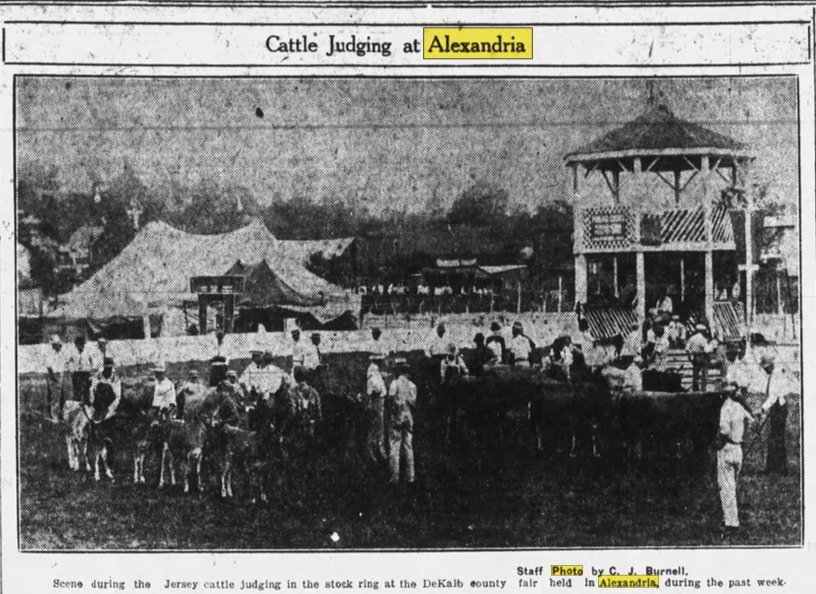
Before the Civil War, Alexandria had become the most prominent and wealthiest town in DeKalb County, a distinction it retained well into the early 20th century. Notably, the DeKalb County Fair, first held in 1856, continues today and is approaching its 170th anniversary.
Fortunately, much of the town’s early land history is preserved, thanks to Thomas Partlow’s transcriptions of the original deed books. One notable excerpt from Deed Book G, page 287 (April 15, 1820), states that lots were to be sold to the highest bidder and that the area north of town — between Cross Street and Spring Street, extending back to the creek — would remain “open commons” for public benefit. This commons, included two springs and land for a future meeting house and school.
By 1854, Alexandria had grown to include 380 residents and 76 qualified voters. Of these, 59 signed a petition to revise the town’s boundaries. These records show the emergence of many founding families—the Goodners, Wheelers, Moores, Briggs, Bairds, Botts, and Fords, among others.
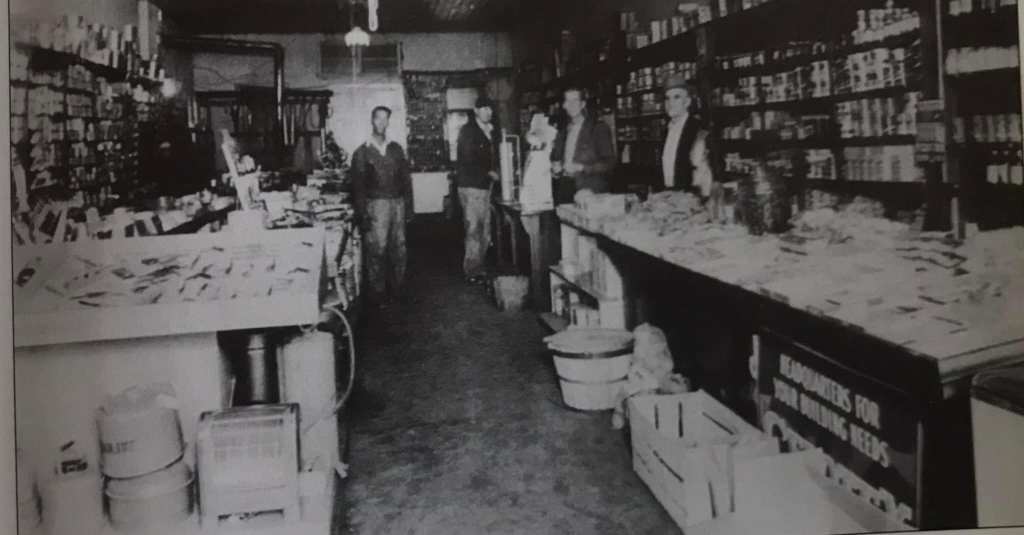
A devastating fire destroyed two hotels and every building on the north side of Main Street. After the disaster, town leaders moved the storefronts back, creating the public square we know today. There was another fire in the 1930’s that burned half of the North Side of the square again, only leaving from the old Corley building damaged but restorable and all the building passed that intact.
In the spring of 1910, Alexandria suffered another emotional blow with the deaths of four prominent citizens in quick succession: Mrs. Jane N’Smith, Fantley Vannatta, Judge Dan Williams, and R.B. Floyd. Along the way several prominent figures have called Alexandria home, including Congressman and Union Colonel William B. Stokes, Confederate Colonel John F. Goodner, Major James Goodner, and even W. E. B. Du Bois for a short while. Their stories and others will be shared in a series of articles.
Source material for this came from Tommy Webb’s files, early Newspaper articles, conversations with Ria Baker, Will T. Hale History of DeKalb County, and Deed books compiled by Thomas Partlow.
 Alexandria Historic Cemeteries District
Leave a comment